RooflineOS
Seasonal field-service platform
Field-service software shaped around a season — measure the roofline from satellite, design the display, quote it, install it, and take it down as one job.
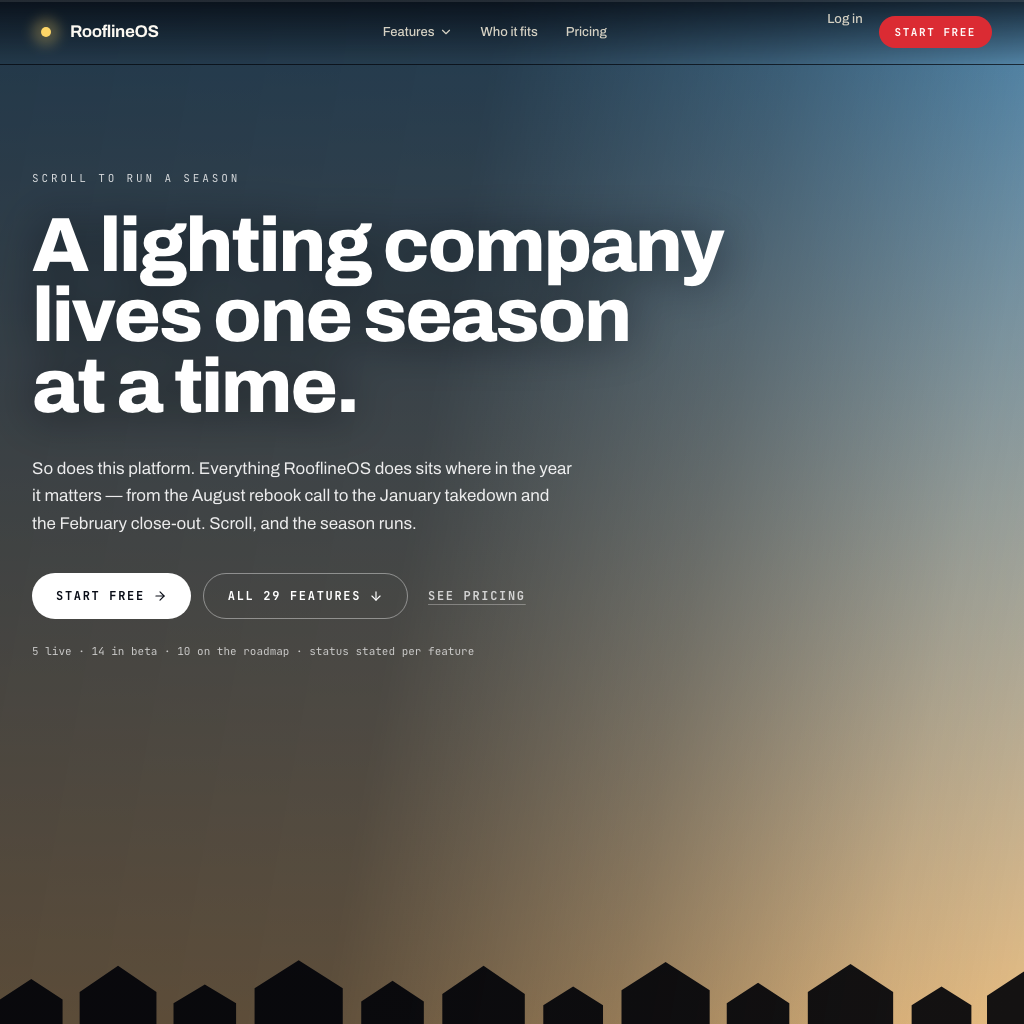
The challenge
A holiday-lighting company does a year of business in ten weeks. Crews are hired in October and stood down in January, materials are paid for months before the customer pays, weather rewrites the schedule overnight, and most of the inventory spends the season on other people’s houses. Nearly every tool sold to contractors assumes an evenly loaded year, so the one job that matters most — the takedown booked in October and performed in January — is the one that falls through the cracks.
“Reach February having installed more properties than last year, without adding office staff, with every takedown done and every invoice cleared.”
The approach
- 01
Made the season the unit of work: an install and its takedown are one seasonal job, so a January takedown can’t be lost from an October sale.
- 02
Put the estimate first — satellite measurement produces linear feet, linear feet produce the price, and the quote goes out on an approval link with no first-visit truck roll.
- 03
Built the lighting-specific pieces — measurement, photo design visualizer, seasonal pairing, linear-foot pricing — as a thin extension package, so everything generic stayed shared.
- 04
Gave the brand its own database, auth, storage, and deployment, so an incident in one product on the platform can’t reach another.
Design iteration
Publishing the roadmap instead of hiding it
The site marks every feature live, beta, or roadmap — and that is a market position, not a pre-launch artifact. Competitors in this category oversell, so stating what has not shipped became the credibility play. It is enforced in code rather than in a style guide: feature status is data, a roadmap feature is excluded from every pricing tier by rule, and a test fails the build if an unshipped feature ever appears in a plan column. Every feature page also states what the feature does not do.
The partnership
How we worked together
The buyer here is on a roof or in a truck all day and evaluates software on a phone at night, so every decision was tested against that person rather than against a spec. Two visual registers were built for one site — a dark brand register for making the argument and a lighter drafting register for comparing plans — and the whole marketing surface was put through an independent design critique and a contrast audit measured from rendered pixels rather than trusted from the browser.
What we built
Highlights of the work
Measure from satellite
An address becomes linear feet of roofline, and linear feet become a price — before anyone drives out.
Design the display
A photo visualizer and property designs turn a proposal into something the homeowner can actually see.
Seasonal jobs
Install and takedown sold, scheduled, and closed as one unit of work across the whole season.
Approve and pay by link
Quote approval, the client portal, and payment all work on first tap — no account for the homeowner to create.
Capabilities demonstrated
Add these to your own project
Let’s talk
Have a project, or a product that could work harder?
Most projects begin with a short, no-pressure discovery call.