CrewlineOS
Field-service platform for trades
Field-service software for trade crews — booking to quote to job to invoice, with nothing re-typed in between.
The challenge
The owner-operator of a small trade business loses money in the gaps between tools. A call becomes a note, the note becomes a quote typed again somewhere else, the quote becomes a job typed again, and the invoice is rebuilt from memory at ten at night. Meanwhile the software sold to them gates the genuinely useful capability — pipeline, review generation, an answering service — behind paid add-ons stacked on an already-tiered plan.
“A working week where the evening admin session simply doesn’t happen.”
The approach
- 01
Built the chain, not the features: booking becomes quote becomes job becomes invoice becomes paid, with nothing re-entered between steps.
- 02
Designed for someone who is not at a desk — interrupted, one-handed, outdoors, phone in a pocket — including a PIN-based time clock, because individual logins are not realistic when crews share a device.
- 03
Removed every step between the customer and “yes”: no account to approve a quote, no login to pay an invoice, no app to download to see when the crew is coming.
- 04
Priced on operational depth rather than basics — and when the audit showed dispatch sitting outside the entry tier while the whole pitch was built on it, moved dispatch down instead of softening the pitch.
- 05
Stood the whole product up as application code and environment configuration only, with no changes to any shared package — the test of whether the underlying platform was actually general.
Design iteration
Marketing copy that cannot drift from the product
Every number on the public site — feature counts, trade counts, what each plan includes — is derived from the same configuration the product reads, so the marketing cannot quietly get ahead of what ships. Fourteen trade pages are generated as real search entry points from that source, and a test asserts the plan badges rendered on each of them match the catalogue. The one unshipped feature is labelled coming soon everywhere and excluded from every tier by rule, so nobody can pay for it in advance.
The partnership
How we worked together
The site went through an independent design critique that returned three dozen findings, and the serious ones were fixed rather than argued with — a contradiction between two contact addresses, a pricing page leading with its own counter-argument, error states that were invisible to a screen reader. Along the way the verification itself got audited: two tests written that week passed for the wrong reason, which is exactly the kind of thing that quietly turns a green build into a false claim.
What we built
Highlights of the work
Quote to invoice, unbroken
One record carries from booking through quote, job, and invoice — the re-typing is the thing being removed.
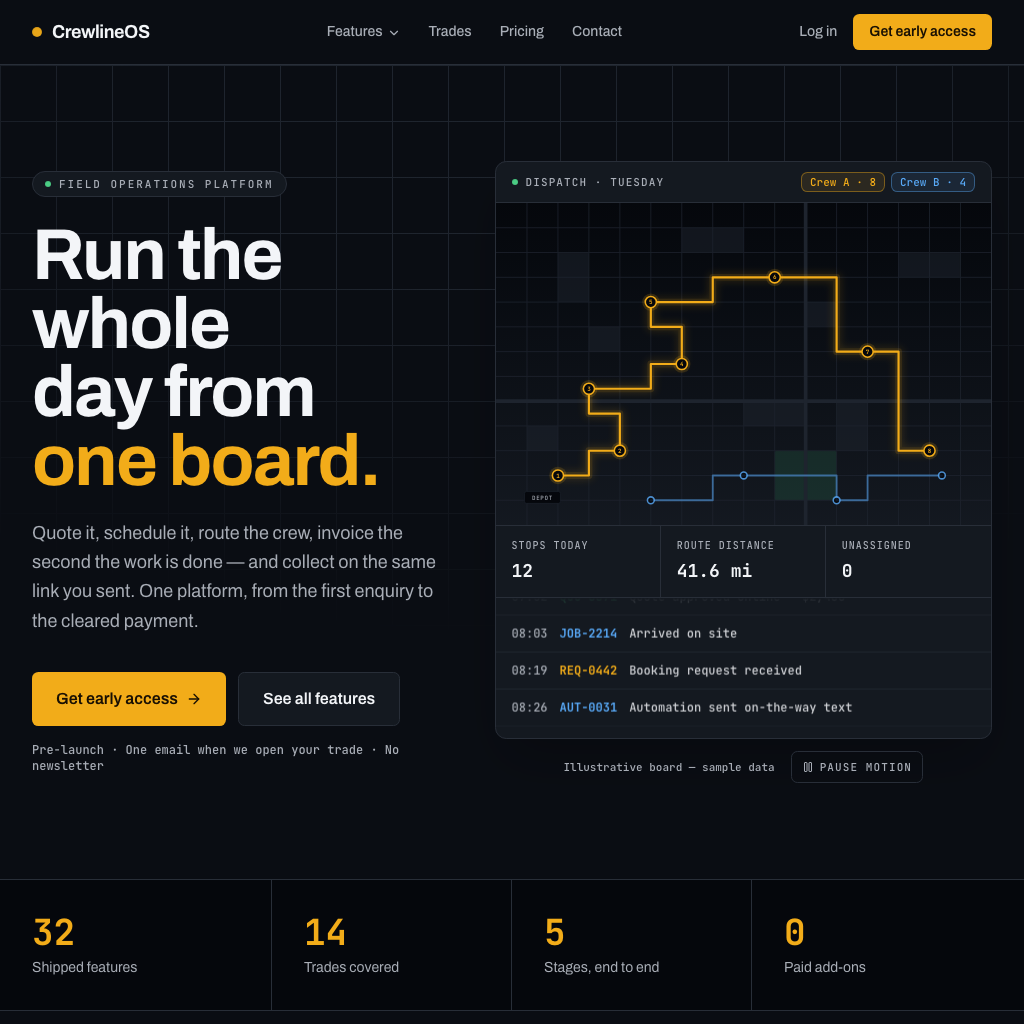
Run the day from one board
Dispatch and routing for the crews, with drive time and access notes treated as first-class facts.
Paid without friction
Scoped links instead of accounts — approve a quote or pay an invoice on the first tap.
Fourteen trades, addressed directly
Individual trade pages generated from the product catalogue, each one a real entry point rather than a template with the noun swapped.
Capabilities demonstrated
Add these to your own project
Let’s talk
Have a project, or a product that could work harder?
Most projects begin with a short, no-pressure discovery call.